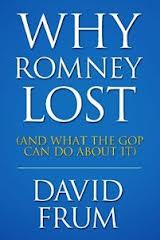
 Note: David Frum's new e-Book is 32 pages. After you read it, please listen to our archived recording of The Middle Ground with David as our guest for a full hour.
Click here for review by Michael Charney
Book review by Eric Byler
Former Bush speech-writer David Frum joined us on Coffee Party Radio on Dec. 4 to talk about his new e-book Why Romney Lost: And What the GOP Can Do About It. The book lays out a compelling argument for why the Republican party’s current approach cannot be sustained, as just about everyone is staying saying in the wake of the 2012 election. But here are two reasons why Frum's approach is the most likely to resonate:
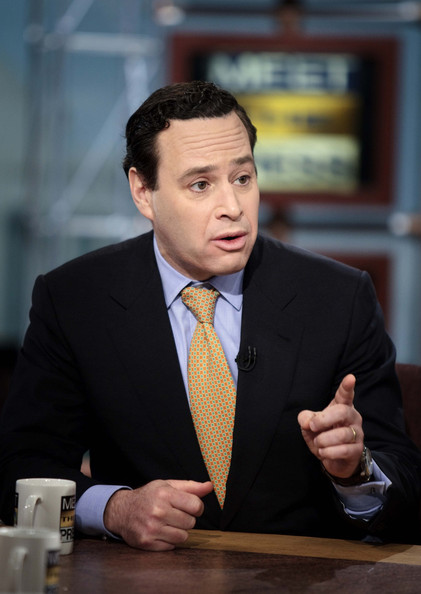
1) David Frum's writing never indulges in gloating or derision. There is no "I told you so" in his tone, even though he has been issuing warnings for years, and, even though many who ignored him treated him viciously in the process.
2) David Frum's compassionate analysis of consumers of Republican media products shows a deep understanding, more respectful and more charitable than that of those who exploited them for personal and political gain.
Tea Party conservatives, Frum reminds us, suffered through the Great Recession too. They saw their home values plummet, their savings shrink, and their children’s futures imperiled just as mainstream America did. Voting for a presidential candidate and seeing a different one win is NOT an attack on one's freedom, nor does it merit a desire to leave the country or secede from the Union. And, Frum shows that most of the other notions that fueled the Tea Party movement were false as well. But, he writes, as if speaking to them directly:
...You will still feel a terrible sense of frustration. And you may feel an even more terrible sense of wrongness if, in the interval, other people with other backgrounds seem to be gaining advantages that you have lost. The words ‘I want my country back’ will acquire poignant, personal meaning.
Starting in early 2009, Republican media products offered its consumers the opportunity to cope with their anxiety, and, ease the guilt they felt for having supported the policies and politicians who brought on the Great Recession. How? By blaming Barack Obama. Frum lists the systematic misinformation campaigns that made that possible, marveling, for instance, at how consumers of Republican media products had been made to believe that taxes had gone up since 2009, and that massive job losses and TARP had begun under Obama rather than Bush.
Frum argues, as other Republicans have of late, that fact-free political advertising, even when disguised as news or entertainment and even when supported by unlimited money, is not enough to win elections because the demographic groups who consume these media products are shrinking. "Nostalgia for a misremembered past is no basis for governing a diverse and advancing nation," he writes. And, pointing to the fact that most Americans under 20 are people of color, he writes:
It is certainly possible for Republicans to choose to be a white person's party. If we do so choose, however, we are also choosing to be an old person's party. Since the elderly receive by far the largest portion of government's benefits, an older person's party will be drawn by almost inescapable necessity to become a big government party. ...The only way to reconcile the voting base and the party's ideology was to adopt Paul Ryan's budget plan, which loaded virtually all the burden of fiscal adjustment onto the young and the poor. And that of course intensified the party's dependence on the old, white voters who set the cycle in motion in the first place.

Frum offers this advice to those who are brave enough to stay in the Republican party and fight for its soul:
We must emancipate ourselves from prior mistakes and adapt to contemporary realities. To be a patriot is to love your country as it is. Those who seem to despise half of America will never be trusted to govern any of it. Those who cherish only the country’s past will not be entrusted with its future.
I hope that we'll discuss the "fiscal cliff" tonight as well. On economic policy, Frum observes that, too often, Republicans appear to be wrapping themselves in the guise of free-enterprise principles while protecting the selfish economic interests of their political donors. What happens when the economic interests of those who made fortunes in the 20th century — and today have the financial muscle to push political parties and even presidential candidates around — are no longer aligned with the best interest of the nation as a whole? Can the Republican party avoid having to make a choice between the economic interests of their donors and those of their constituents? Perhaps not if they take Frum's advice. But if they do take that advice, we will have a stronger, more viable Republican party, and, more importantly, a stronger, more viable country with real choices for voters, and, with an economic approach that will allow us to compete in the modern, global economy.
Purchase and download Mr. Frum’s book, Why Romney Lost, here.
Read Eric Byler's previous blog about David Frum from Nov. 2011.
 Politics Done Right
 by Eric Byler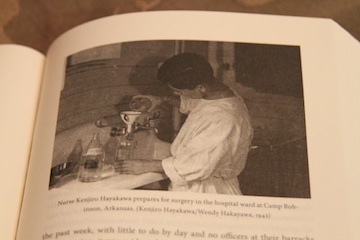
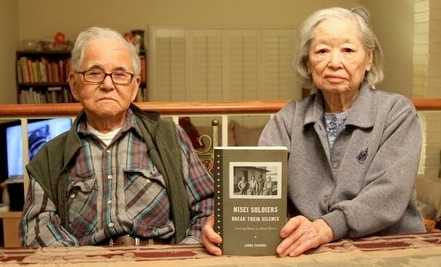
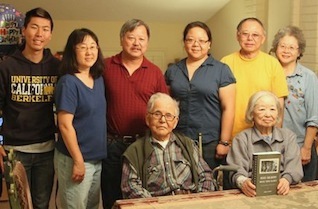 As my sister snapped the photos you see here, it occurred to me that this family, like many Japanese American families today, would not have to come to be if not for an historic injustice. And, I thought about how I might never have known about Kenjiro's heroism if not for a book providing me the opportunity to ask about it.


 Sue said both of Hal’s parents died the same way.
 by Don Manning